A solo, created and performed by Lee Mun Wai.
22.10.2024, 20.30hr. Uferstudios. Berlin, Germany.
Presented as part of an 8-day participatory installation and performance, STARDUST, under the direction of Ming Poon (Berlin).





REVIEW BY WINIFRED WONG
Lee Mun Wai conceives a deeply personal, emergency East Meets West ritual to mourn an ex-partner.
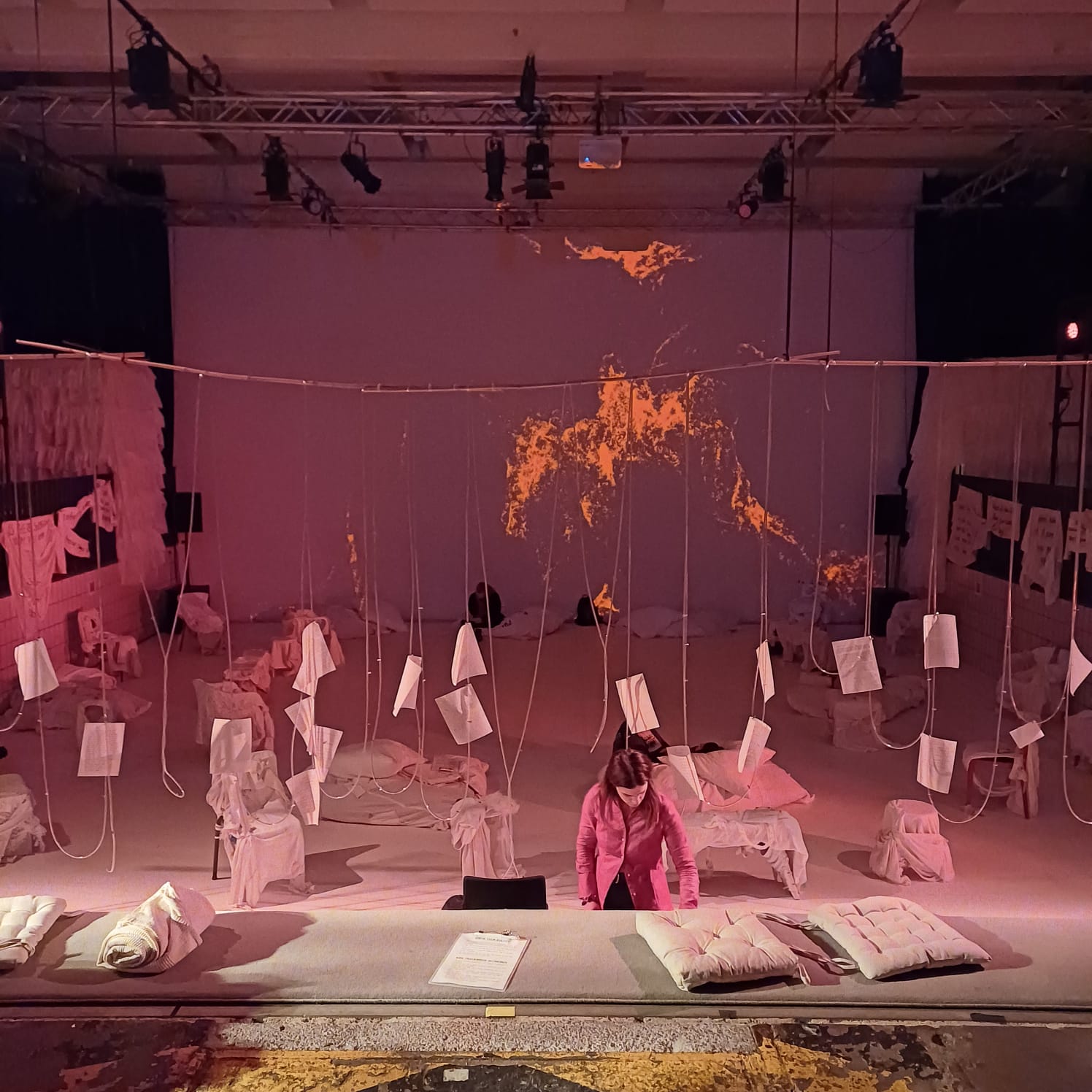
It is a chilly autumn night, but the doors to Studio 1 at Uferstudios are wide open. From the outside, one sees the entire space, with no corners threatening surprises or jumpscares. It is Halloween season, and some might expect an art installation about death to look different, perhaps dark, with spooky skulls or Ouija boards.
At Stardust, an installation by Berlin-based Singaporean artist Ming Poon, there are no hard edges. Everything is soft and light. Almost every surface is covered in white and beige cloth of different materials and textures. They have been patched together quilt-like by stage designer Sichi Li, creating a tactile, inviting space.
I silently commend the other visitors in the space. I imagine them reading the program and deciding they would be down for an evening contemplating not just death, but their own. Clipboards around the space invite visitors to write their eulogies, and a 17-minute audio guide instructs listeners to practise dying. White clothes hang on both sides of the exhibition. In painted letters, a large t-shirt asks me, “How do you envision the world without you to be like?” and it has (seemingly intentionally) a gaping word-shaped hole. A tea towel questions: “What is the last thing you want to say?” There are full outfits as well, and I imagine them to have belonged to somebody who has since passed away, when clothes are no longer needed to encase the modesty of their meat suit.
Seating comprises chairs, benches and beanbags. I am in semi-supine on a comfortable bean bag, a position that encourages deep breathing, as I settle in to listen to the audio guide. My heart quickens when the meditative, calm voice (belonging to AngieM) tells me to imagine that the next few breaths will be my last. I am aware this is just play pretend, but isn’t there just the faintest possibility that what the voice says is true?
On a large wall opposite the entrance, there is a projection by video and projection designer Harshini J. Karunaratne of what looks like particles drifting in the cosmos, combined with a reverberating ticking in collaboration with sound designer Haesoo Jung. I imagine this to be a
visualisation of the exhibition’s name, Stardust. When I walk into the centre of the space, a light appears at my feet and follows me around like a spirit, as if I would already be dead, and I existed only as mere light. Plastic tubes that look somewhat like hospital breathing tubes hang down in vines for freshly written eulogies to be attached to them. The content of the “Instructions on Dying” audio guide is clinical, as if I were at a morgue. It directs one through a restful death, one that not all of us will get but can at least hope for. 17 minutes take no time at all, and suddenly I’m at the end, opening my eyes to the dim light, confronted by yet more questions from a pair of trousers and a vest.
Before Lee’s show, death doula Alessa Rhode delivers a comprehensive briefing in both German and English on content triggers and sensory stimuli. A retreat room is made available. Earplugs and sensory rings are provided. We are mentally, and quite literally, cushioned and thoughtfully guided into exploring a topic that requires care and sensitivity.
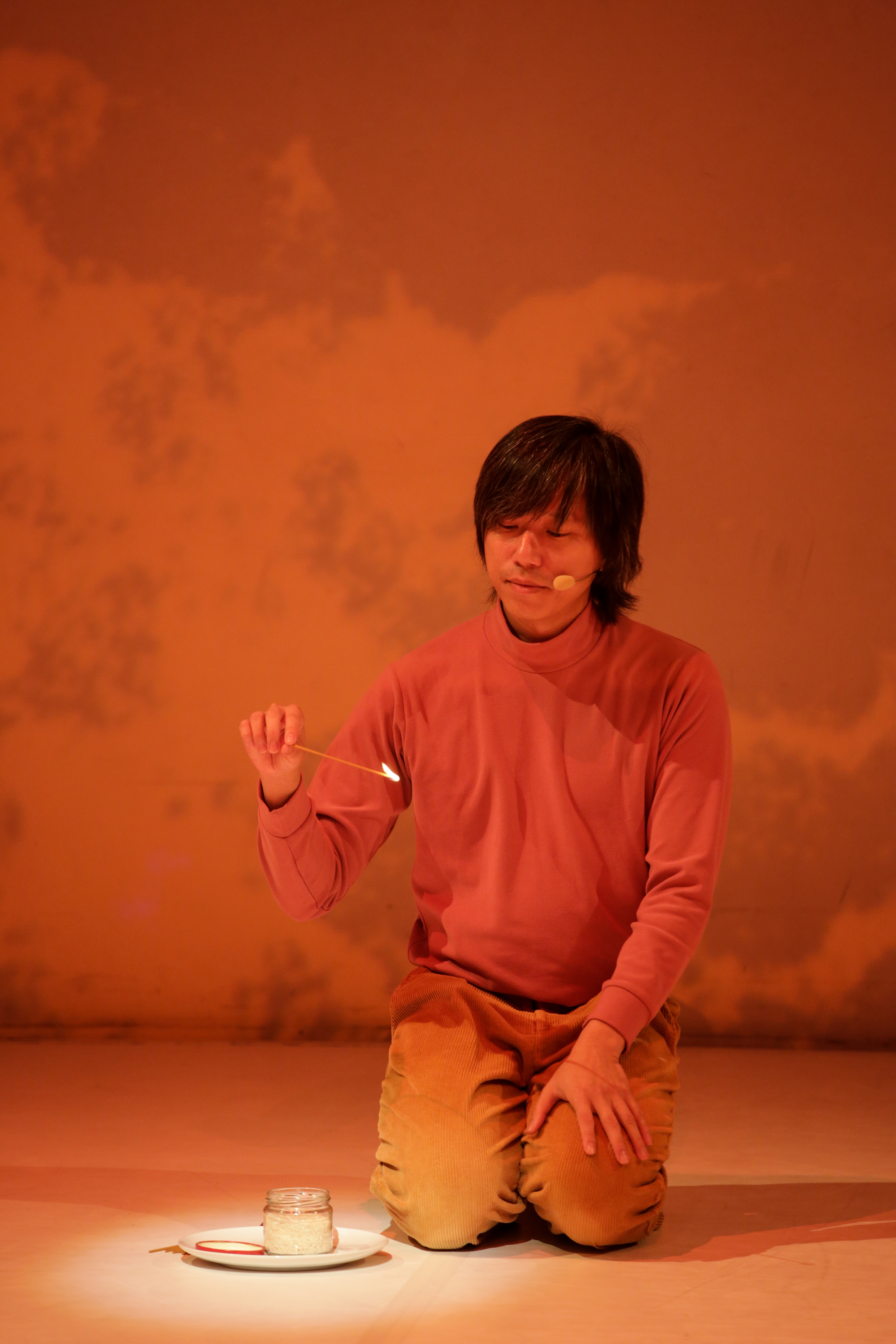
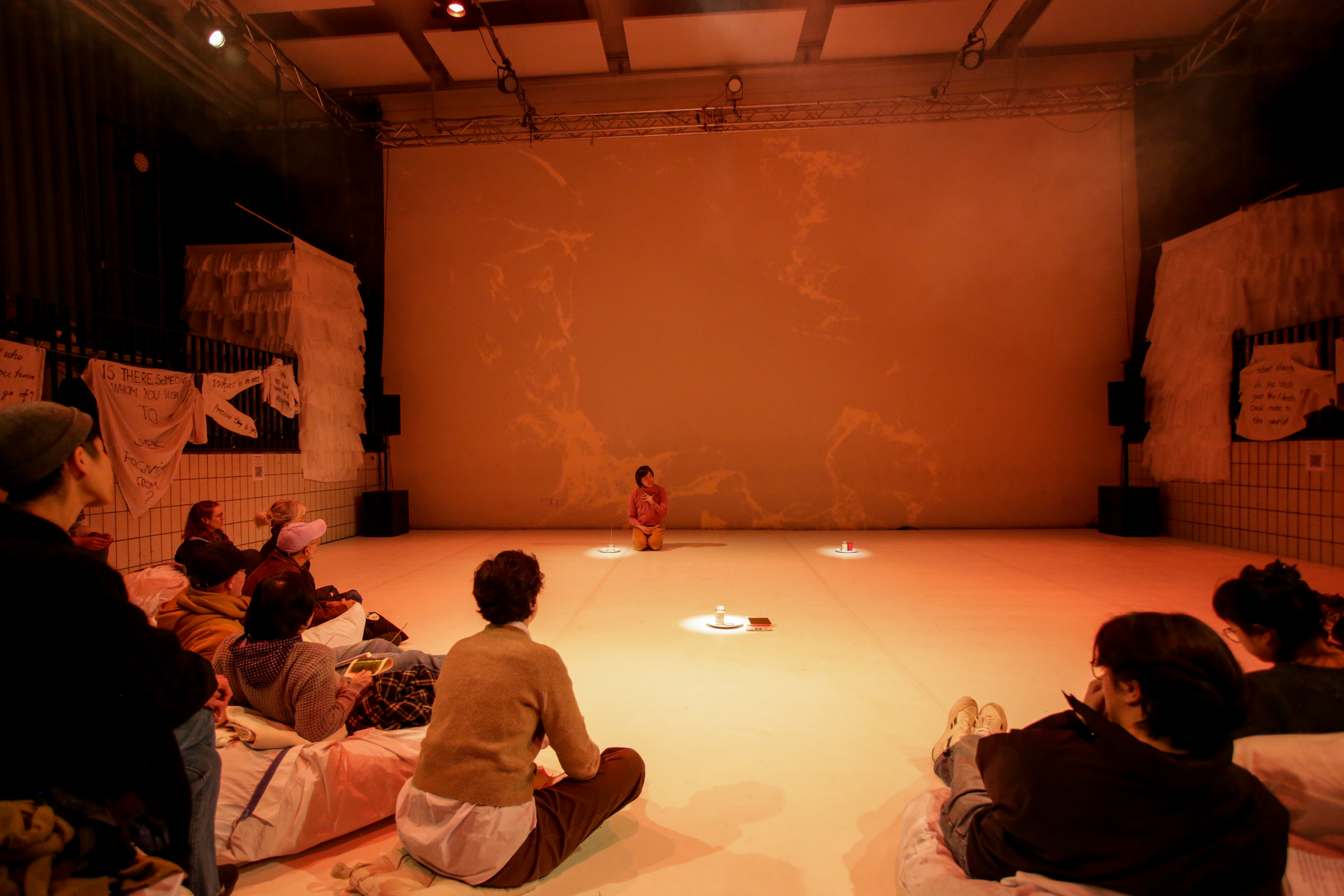
The theme for today’s ritual is fire and is dedicated to Lee’s ex-partner whom he lost to pancreatic cancer. Lee enters the stage and says that he has been performing for 15 years, but only now has his art come so close to his personal life. It is a bold declaration, and observing such a frank confession is satisfying.
Joss paper is distributed. These bamboo sheets centred with metallic foil are commonplace at Taoist funeral wakes back in Singapore, though Lee notes wryly that he once saw this paper used in a WG in Berlin as decoration. (As with all appropriation, we can only guess if it is done out of ignorance or knowingly as an ironic statement.) A stick of incense is also given out. It smells nuttier, spicier than the incense sticks I am used to in Singapore and Malaysia, or perhaps I had never sniffed them at such proximity before. It is comforting, and I hold it to my nose to distract myself from my tears as “Gute Nacht Freunde” by Reinhard Mey starts playing. At the funeral, the same song was played at the Friedhof Kappelle (cemetery chapel).
Lee sets up a makeshift altar within the audience: A photo frame of his ex-partner on a small table with an offering of an Augustiner beer and candles. Makeshift incense holders are placed alongside tabernacle candles on stage. Joss paper sits companionably beside fake dollar bills for burning. The point is clear: East and West are juxtaposed, as Lee and his ex-partner were in their relationship, and both sides are given the space to exist alongside each other.
Lee then contrasts a typical wake in Singapore with a church funeral in Germany. This is where the cultural gap slowly reveals itself: mood, length, sounds, expectations, guests’ behaviour, etc. Instead of cymbals, there were bells; instead of repetitive chanting, there was a eulogy. I already knew this, having attended some Christian funerals in Singapore, but understanding this through a personal story was quite different. In Singapore, the plurality of religions allows for different ways of grieving that are witnessed and acknowledged by others. In Germany, the prevalence of Christianity exposes residents to an accepted and visible form of ritual, which marginalises or even exoticises rituals from minority religions.
Alongside a matter-of-fact delivery of the story and his emotions leading up to the ritual’s conception, Lee cracks frequent self-deprecating, tongue-in-cheek jokes, consistent with a pragmatic approach to mourning. Humour is a coping mechanism, of course, but perhaps because I was prepared by the performance’s premise, I found myself desiring rawer grief and emotionally denser moments to be portrayed to counterbalance the humour, which was ever-present and created a varnish over what I hoped to be more bittersweet. I wanted to be pulled in different directions like a rubber band; I wanted the emotional gravity and resulting tension to wring my heart out. Letting the grief show also normalises it, permitting the audience to do the same. That said, this approach would have been more emotionally taxing, and of course, an actor has full prerogative over how to perform such a personal narrative.
The ritual is revealed. At home, Lee lights a joss stick and talks to his ex-partner for the duration of the joss stick, finishing on an ‘amen’ – “Just to make sure my message gets there,” Lee jokes. Incense sticks were used in ancient times to tell time, like how an incense stick length of time is dedicated daily to his ex-partner. I think about how important the semblance of normalcy is for people who are grieving, and how we are obliged to carry the present by giving care to the past and the future. I think about all the people that I didn’t get to meet because of death, the people I met and then had to say goodbye to, and the people I will not get to meet because I have died.
Collectively, we fold joss paper into ‘golden ingots’. We offer incense sticks to our departed loved ones and plant them into one of the four incense holders. In wakes in Singapore, it is widely accepted that Christians do not hold or offer incense sticks to the departed. Here, I am heartened to see that almost everyone offers a stick of incense regardless of their religion.
We are then invited outside to burn the paper ingots we folded as offerings to the dead. A cold wind is wresting loose dead leaves from trees. The burning of the ingots takes place on a “Feuerschale” (loosely translated to “fire bowl”) as if it were a bonfire, and what is a bonfire than a spectacle, a demise, a destruction, a changing of form? There is a satisfying finality to burning something, that what you held in your hand just moments earlier could disappear but yet still be there, transformed but somehow the same, less but not lesser. We can’t tear our eyes away from the flames. Quite possibly, it is a stand-in for the actual cremation. The burning of offerings is merely a ritual that we can bear to watch, a reminder that we are finite, that we are matter that can burn, becoming dust like what the incense leaves behind.
Lee jokes about this being a Western Union, a portal between life and death, a customs of sorts. The smell of incense and burning joss paper is also a portal back home, awakening nostalgia. Smoke permeates our clothes like clinging grief. We watch the smoke rise to the skies, bringing our wishes to meet the stars.
As someone who has grown up privy to these funeral rites, I found familiarity and comfort in their portrayal in a foreign land, but I also found myself craving the meanings behind the rituals. By that I don’t mean the cerebral meanings – I mean oral wisdom, the kind of answers you get from your parents, who got them from their parents. Taoist rituals have centuries of wisdom encased in a simple action, and I wished to hear about the beliefs surrounding them in more detail. Perhaps this could have been explored more comprehensively given more time and space.
The performance ends and the space stays open afterwards, a thoughtful gesture for audience members to stay on. It is a gentle way to round off the performance, avoiding the edge that a sharp ejection into the night would bring. The incense sticks that everyone has lit stay burning for a long time after, stinging our eyes the same way that visiting Buddhist temples in my youth would, the smoke enveloping us in a fragrance that reminds us of warmth-providing campfires, hearths, and fireplaces. I talk to a group of Vietnamese friends afterwards, and we discuss the similarities (keeping vigil overnight, open caskets, joss sticks) and differences (joss paper) between Singaporean and Vietnamese funeral rituals.
While cleaning up, Lee told me he would like to drink the beer he offered at the altar, and I was surprised to learn that the beer was freshly opened. I had assumed the beer bottle was a prop, but I realised what we had just witnessed was not play pretend. I notice that the incense stick for Lee’s ex-partner is still burning, and I’m comforted to think that the entire performance tonight, and all the conversations in between, was conveyed to him via interworldly means.
As a frequent visitor to the Edinburgh Fringe, I was struck by how much Lee’s show resembled the one-person, exposition-led shows typical of the Fringe. Lee tells me he wanted his grieving process to be as transparent as possible, and he found storytelling and ad-libbing through a script to be the most sincere way of conveying it. The performance felt short to me, considering wakes in Singapore last several days, with the
bereaved staying overnight to watch over and accompany their dead, and Lee concurred. “We need time to sink into grief,” Lee says. In addition, offerings over the next 49 days are made after the cremation or burial, which would admittedly be too much ground to cover in a 30-minute performance. Nevertheless, I found myself wishing that the audience could have also been exposed to the full ritual. “At least the length of a church funeral,” I thought childishly, because a part of me
wanted equal space to be granted, for every ritual to be similarly valid and acknowledged in Germany, so a ritual of contingency did not need to be conceived.
We chat about the wakes usually held in void decks in Singapore. Void decks are the areas on the ground level of public housing buildings in Singapore that are deliberately kept empty (therefore, a void) for a variety of reasons, including community events. As such, one could easily walk past a wake on their way to work, the openness reminding us that death is present, and not squirrelled away in a building on special occasions. He laments the religious hegemony of Christianity in Europe and the way that architecture in Germany is seemingly resistant to the aesthetic manifestations of other religions. These are often choreographed to the edges, marginalised to industrial buildings in suburban areas instead of being points of interest in their own right.
When asked about whether it was difficult to procure materials for the ritual, Lee laughs, “It was very unsexy lah.” Set designer Tin Wang flew back to China to bring back mourning items that were used in the show. For rehearsals, they bought incense sticks and joss paper from local Asian supermarkets, although he was careful to avoid the ones with Chinese characters, which were more for worship than for mourning. I asked if he would have liked to replicate the wake in Berlin at the scale it is performed in Singapore. The burning would be done in a large metal grate, with flames reaching up to three storeys and many more paper offerings. He says the big courtyard outside Uferstudios would have been perfect for it. Somehow, I wished for this reclamation, for us to take the space to perform our history in a foreign land.
Did he wish he had performed this ritual for his ex-partner’s friends at the funeral? “I don’t think they need this ritual as urgently as I did,” Lee laughs. Lee was the only non-German and non-Christian at the funeral and experienced, privately and acutely, a need for closure which was not resolved by the church funeral. “That’s why I came up with this ritual, as my special way of communicating with my ex-partner. It’s the first time as a performer that I don’t feel the need to share it so openly with others,” he says.
‘Ritual of Contingency’ was performed at Uferstudios, Badstraße 41a, 13357 Berlin on 22 October 2024, as part of a larger 8-day Participatory, Performance-Installation titled, STARDUST. STARDUST is a project initiated by choreographer Ming Poon.
In fond memory of Michael Mücke.
Winifred Wong is a Singaporean poet, writer, and performer based in Berlin. Her poetry has appeared in SAND Journal, Softblow and SingPoWriMo, among others. She has covered cultural events and current affairs with arts institutions such as Esplanade Theatres and news outlet Yahoo!.
Top 2 photos: Lee Mun Wai. / All other photos: Olivia Kwok.
 lee mun wai